
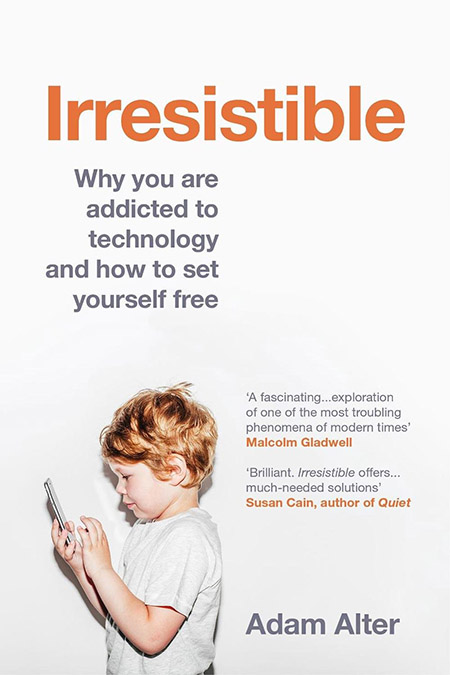
sychologist Adam Alter explains why we're addicted to technology and offers essential solutions for a happier life.
In some ways this is not surprising, as our world is filled with addictive experiences- from social media and messaging, to rolling news and video streaming. Attention spans are decreasing as our time spent glued to our screens are increasing, negatively affecting our ability to relax, sleep, develop relationships and achieve meaningful goals. Psychologist Adam Alter provides insight into why, explains the science behind why we can't seem to stop such behaviour and offers practical advice for using technology differently, in order to lead a happier life, and to set yourself free.
This examination of today's tech-zombie epidemic is worth putting your phone down for' Guardian'Essential reading... Regain control of your time, finances and relationships'Charles Duhigg, author of The Power of Habit.
Buy the book on Fishpond.

There's a new addiction in New Zealand - more than a third of Kiwis say they are hooked on their screens and many are blaming Covid for it. As the country enters its second week of lockdown, New Zealanders have been averaging five hours of screen time a day on top of using devices for work and school since the Covid pandemic started last year, a new NortonLifeLock study has found.
Read More
In the past few years internet addiction (IA) and internet gaming disorder (IGD) have become very frequent, leading to many personality and psychiatric disorders including low self-esteem, impulsivity, poor sleep quality, mood disorder, and suicide. IA has been included in Appendix III of the Diagnostic and Statistical Manual for Mental Disorders (DSM-5) as IGD. In addition, IA leads to many neuroanatomical and neurochemical alterations including cortical thinning of various components of the brain and altered dopaminergic reward circuitry.
Read More
As this 60 Minutes report discovers, you can have too much of a good thing. What's being called “Internet Addiction Disorder” is ruining lives and even changing the way our brains process information. Worse still, experts are seeing dangerous signs in toddlers.
Read MoreWe greatly appreciate your feedback on this website and would like to know what information you found useful and what services you would like to see next. Please take a couple of minutes to let us know.
survey


